
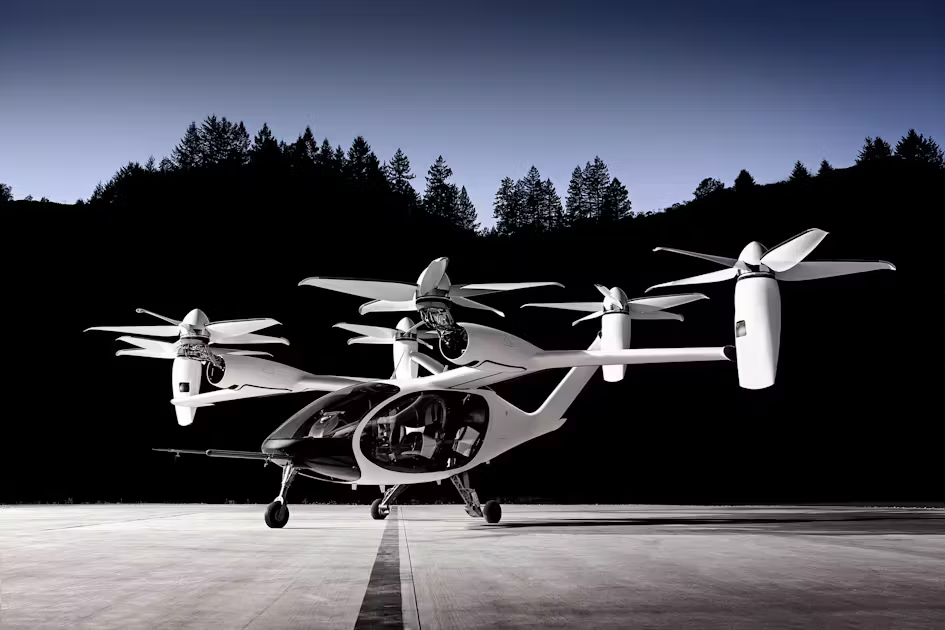
The likelihood of autonomous travel becoming mainstream within the next decade hinges on technological advancements, regulatory frameworks, and public acceptance. Industry forecasts and Joby Aviation’s progress suggest a strong trajectory toward adoption, particularly in air travel.
Groundwork and Timeline
- Current State: Autonomy in aviation is already here in limited forms. Modern commercial airliners use autopilot for 90–95% of flight time, handling navigation and landings in controlled conditions. Drones, including those for military and logistics use, operate autonomously today, with the FAA reporting over 1 million registered drones in the U.S. as of 2024.
- 5-Year Outlook (2025–2030): Experts predict that urban air mobility (UAM), driven by eVTOLs, will see commercial deployment by 2028–2030. Joby Aviation, for instance, plans to launch passenger air taxi services in Dubai as early as late 2025 or early 2026, per their February 2025 Q4 report. Morgan Stanley projects a $1.5 trillion market for autonomous aircraft by 2040, with significant growth starting in the late 2020s.
- 10-Year Outlook (2030–2035): By 2035, analysts from McKinsey estimate that 15–20% of short-to-medium-distance travel (under 150 miles) could shift to autonomous air vehicles in urban areas, assuming regulatory hurdles are cleared. The Autonomous Aircraft Market is expected to grow from $7.2 billion in 2023 to $22.71 billion by 2030 (Fortune Business Insights), a CAGR of 17.8%, signaling robust expansion.
Joby Aviation’s Role
Joby Aviation, valued at a $5 billion market cap as of March 2025 (per X posts), is a key player accelerating this timeline. Their all-electric, autonomous-capable eVTOLs have logged significant milestones:
- Certification Progress: In 2024, Joby completed record progress on FAA certification, a critical step toward commercial operations.
- Military Collaboration: Joby delivered its second autonomous Cessna 208B Grand Caravan to the U.S. Air Force in 2024, demonstrating military use cases during the Agile Flag 24-3 exercise.
- Global Expansion: Joby signed an exclusive deal with Dubai in 2024 to operate air taxis, with the first vertiport under construction as of early 2025. They also conducted successful demo flights in Korea in 2024.
- Financial Backing: With $933 million in cash reserves (Q4 2024), Joby is well-funded to scale production and operations.
Given these achievements, Joby’s target of late 2025 or early 2026 for passenger services suggests autonomous air travel could be operational in select cities within 2–3 years, with broader adoption likely by 2032–2035 as infrastructure (e.g., vertiports) and regulations mature.
Probability Estimate
Considering Joby’s momentum and industry trends, there’s a 70–85% chance of autonomous air travel (e.g., air taxis, small cargo drones) being commercially available in multiple regions by 2030, expanding to widespread use (10–20% of urban travel) by 2035. Fully autonomous large-scale airliners, however, are less likely within this timeframe, with experts like Boeing’s John Tracy noting that certification and public perception could delay such advancements beyond 2040.
Joby Aviation’s Innovations
Joby Aviation stands out with its eVTOL technology, blending autonomy with sustainability:
- Aircraft Design: Their five-seat eVTOL, capable of 200 mph and a 100-mile range, uses six electric motors for quiet, efficient flight. It’s designed for autonomy, with onboard systems managing navigation and obstacle avoidance.
- Testing Milestones: Joby has conducted over 1,000 test flights since 2017, refining its autonomous systems. Their 2024 Air Force trials showcased a Cessna retrofit flying autonomously alongside a C-130 Hercules.
- Infrastructure: Joby’s Dubai vertiport project, set for completion by 2026, integrates air taxis into urban transport networks, a model they aim to replicate globally.
These innovations position Joby to lead the Advanced Air Mobility (AAM) sector, potentially capturing a significant share of the projected $1.5 trillion market by 2040.
Risks of Autonomous Travel
While promising, autonomous travel introduces notable risks:
- Safety Failures: A 2023 World Economic Forum report highlights that system malfunctions (e.g., AI errors, sensor failures) could lead to accidents. Human pilots currently mitigate 80% of general aviation incidents caused by human error—removing them entirely shifts reliance onto unproven tech.
- Regulatory Delays: The FAA and EASA are still developing frameworks for autonomous flight. Joby’s 2025–2026 timeline depends on regulatory approval, which could falter if safety standards aren’t met.
- Cybersecurity: Autonomous drones and planes are vulnerable to hacking. A 2022 study by Lockheed Martin noted that cyberattacks on UAVs increased 30% year-over-year, posing risks to passenger safety and data privacy.
- Public Trust: McKinsey’s 2021 survey found only 15–20% of people are ready to fly in pilotless aircraft, citing fears of accountability if something goes wrong.
Benefits of Autonomous Travel
The upside of autonomy, as Joby Aviation exemplifies, is transformative:
- Safety Enhancement: Joby claims autonomy reduces human error, which accounts for 80% of aviation accidents. Their systems use redundant sensors and AI to detect and avoid obstacles, potentially exceeding human reliability.
- Cost Reduction: By eliminating pilots and optimizing flight paths, Joby’s eVTOLs could cut operating costs by 30–50% compared to helicopters, per Morgan Stanley estimates, making air travel more affordable.
- Sustainability: Joby’s electric aircraft produce zero emissions, aligning with 2025’s push for greener transport. This could reduce aviation’s 2% share of global CO2 emissions.
- Accessibility: Autonomous air taxis could serve underserved areas, reducing travel time (e.g., a 100-mile trip in 30 minutes vs. 2 hours by car). Joby’s Dubai plan aims to democratize air travel, a vision echoed by Honeywell’s AAM initiatives.



 Tech Gadget Hub
Leave a comment