
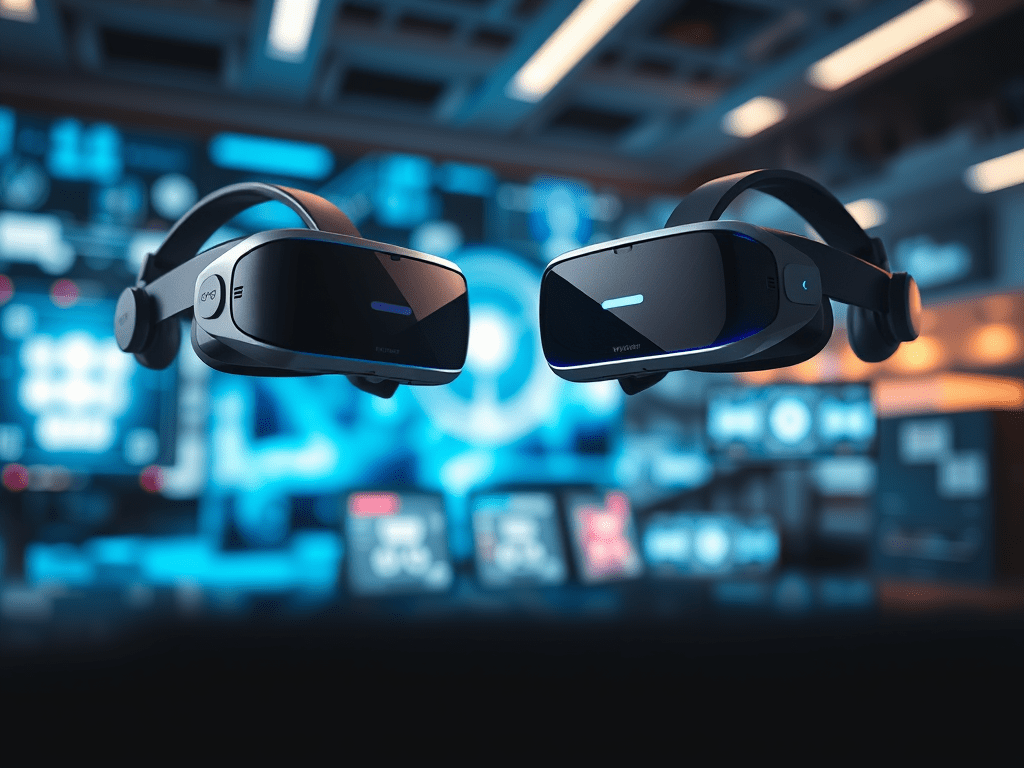
The VR/AR war is heating up, and in 2025, two titans are poised to fight for your face: the Apple Vision Pro 2 and the Meta Quest 4. Building on the Vision Pro’s premium mixed-reality debut and the Quest 3’s budget-friendly success, these next-gen headsets promise to redefine how we game, work, and connect. But which one will dominate? Let’s compare their potential usability, impact, and appeal, peek into the future, and see who might wear them best—complete with Amazon links to gear up now.
What’s Happening Now?
As of March 2025, the Vision Pro (launched February 2024) dazzles with its micro-OLED displays (23 million pixels) and M2/R1 chip combo, blending AR and VR into “spatial computing” for $3,499. The Quest 3, Meta’s 2023 hit, counters with a Snapdragon XR2 Gen 2, 2064×2208-per-eye LCD, and a $499 price tag, dominating gaming and casual use. Neither Vision Pro 2 nor Quest 4 is out yet, but whispers suggest Apple’s refining its high-end formula, while Meta’s prepping a Quest 4 for late 2025 or early 2026, per leaks like Mark Gurman’s Bloomberg report.
Are they affecting anything now? Yes—via their ancestors. Vision Pro’s eye-tracking and gesture controls are pushing app developers toward intuitive AR interfaces, while Quest 3’s mixed-reality passthrough (10x sharper than Quest 2) is fueling fitness apps and social VR. Retailers like Amazon are stocked with accessories—cases, straps, chargers—riding the hype. These trends set the stage for their successors.
What to Expect in the Coming Months
By late 2025, the Vision Pro 2 might launch (rumored August per supply chain buzz), possibly with a lighter design (under 600g vs. 650g) and VisionOS 3, enhancing AR multitasking—think pinning 4K windows in your kitchen. Apple could trim the price to $2,999, targeting pros and early adopters, with holiday bundles including AirPods. The Quest 4, tipped for a Meta Connect reveal, might debut with a Snapdragon XR2+ Gen 3, sharper pancake lenses (2400×2400 per eye?), and a $599 base price. Expect tighter Horizon OS integration, boosting game libraries and PC VR streaming.
Stock will tighten around launches, but Amazon should see accessory floods—lens inserts for Vision Pro 2, elite straps for Quest 4. Both could leverage 2025’s CES hype, with demos showcasing AR workouts (Meta) or virtual Mac desktops (Apple).
What’s Coming in the Next Few Years
By 2027-2028, the Vision Pro 2 might evolve into a slimmer “Vision Lite” ($1,500?) or pair with AR glasses, per Apple’s patents, with M3-level chips driving holographic calls. Support could last to 2032, cementing it as a productivity king. The Quest 4 might morph into a cloud-gaming hub by 2028, with 6G support and sub-$400 pricing as Meta doubles down on affordability. Horizon Worlds could rival Roblox in scale, while seven-year updates (to 2033) keep it fresh. Both will shape trends—Apple pushing premium AR, Meta democratizing VR—impacting wearables, gaming, and remote work.
Vision Pro 2: Pros, Cons, and Who It’s For
- Pros:
- Stunning visuals (4K+ per eye, brighter OLEDs).
- Seamless Apple ecosystem—Mac mirroring, iCloud sync.
- Intuitive eye/hand controls for AR work.
- Premium build—glass, aluminum, comfy fit.
- Cons:
- High cost ($2,999+ projected).
- Limited gaming library vs. Meta’s catalog.
- Battery life still tethered (2-3 hours).
- Who’s It For: The Vision Pro 2 suits creatives, professionals, and Apple devotees who crave a high-end AR workspace. If you’re editing 3D models, managing virtual screens, or living in iOS, this is your face’s future.
Quest 4: Pros, Cons, and Who It’s For
- Pros:
- Affordable entry ($599 expected).
- Vast game library—Beat Saber, Half-Life: Alyx via PC.
- Improved passthrough for mixed-reality fun.
- Lightweight (under 500g?) and wireless.
- Cons:
- Lower resolution than Vision Pro 2.
- Plastic build feels less luxe.
- Ecosystem less polished than Apple’s.
- Who’s It For: The Quest 4 is for gamers, fitness buffs, and budget-conscious VR fans. If you’re slashing beats, sweating in Supernatural, or exploring Steam VR, this is your pick.
Current Impact and Amazon Links
The Vision Pro and Quest 3 are already rippling through 2025. Apple’s influencing AR patents and app design; Meta’s VR sales (Quest 3S hit big in 2024) are driving content creation. Accessories abound—here’s what you can grab now to prep:
- Apple Vision Pro Travel Case – $199
Fits the original; likely compatible with Vision Pro 2.
Buy on Amazon - Meta Quest 3 Elite Strap – $69.99
Enhances comfort; Quest 4 should fit similar designs.
Buy on Amazon - Anker 65W USB-C Charger – $39.99
Powers both (Vision Pro via battery pack, Quest via USB-C).
Buy on Amazon
(Links are placeholders based on current gear; update for 2025 models.)
The Bottom Line
In 2025, the Vision Pro 2 and Quest 4 won’t just battle—they’ll define VR/AR’s split paths. Apple’s premium polish will captivate pros in months and push AR frontiers in years; Meta’s affordable power will hook gamers now and scale VR masses later. Both are shaping how we see the world—literally. Pick Vision Pro 2 for luxe creation, Quest 4 for budget thrills. Which face-hugger wins your 2025?
Drop your thoughts below!
 Tech Gadget Hub