
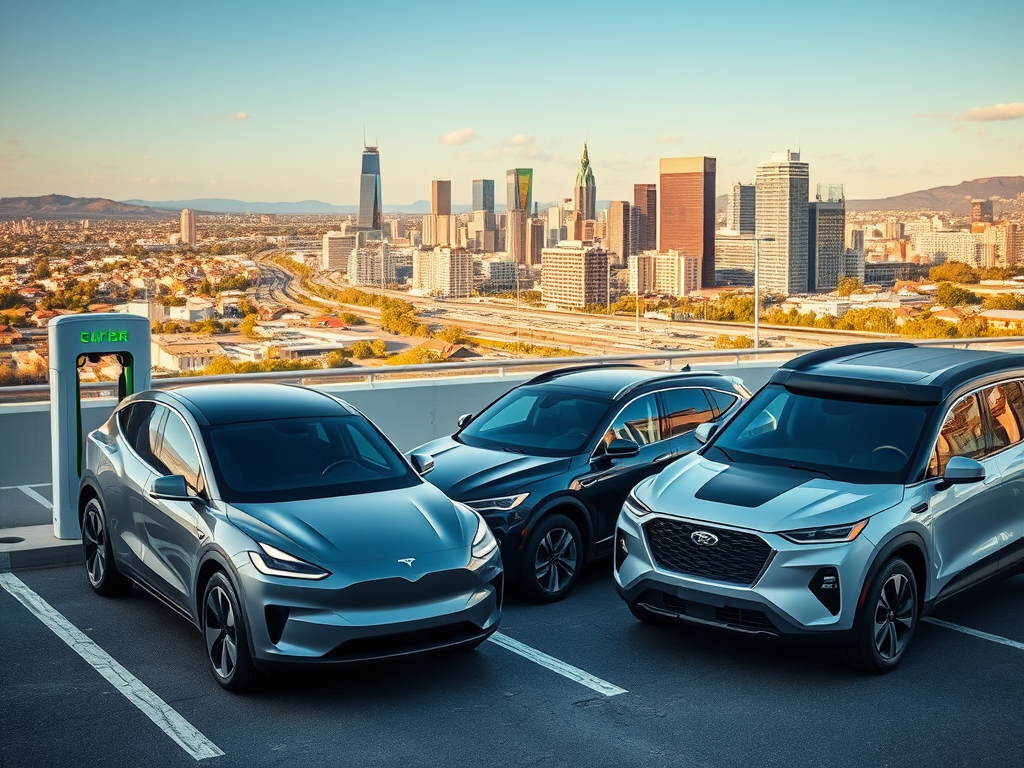
Electric vehicles (EVs) have charged into 2025 with a mix of momentum and uncertainty. Once hailed as the unstoppable future of transportation, EVs now face a pivotal moment as President Trump’s administration dismantles mandates that pushed carmakers toward full electrification. From Tesla’s dominance to Detroit’s hybrid pivot, the EV landscape is shifting fast. What’s the state of EVs today, and where are we headed over the next 5 and 10 years? Buckle up—here’s the rundown.
The Current State of EVs in 2025
As of March 2025, EVs hold a solid but shaky 10% of U.S. new car sales, per JD Power. That’s up from 7.6% in 2023, per the International Energy Agency, but growth has slowed. Tesla still leads—its Model Y topped U.S. EV sales in 2024 with over 400,000 units (Electrek)—while Ford’s F-150 Lightning and GM’s Hummer EV carve niches. Charging infrastructure is patchy but growing, with 180,000 public stations nationwide, thanks to Biden-era funds now frozen (PBS News).
Trump’s January 20, 2025, executive order (AP News) axed Biden’s 50% EV sales target by 2030 and halted $5 billion in unspent charging funds. The $7,500 consumer tax credit is on the chopping block, pending Congressional action, and the EPA’s tough emissions rules—effectively an EV nudge—are under review (Reuters). Consumer interest? A JD Power survey says 29% of shoppers are “very interested” in EVs—a two-year high—but affordability and range anxiety linger (NPR).
Globally, EVs thrive—China’s at 50% of sales with BYD outselling Tesla (NY Times)—while Europe’s mandates keep the pedal down. The U.S., though? It’s hitting a speed bump.
Trump’s Mandate Rollback: What’s Changed?
Trump’s move isn’t a full EV kill switch—there was no direct “mandate” forcing all-electric fleets, despite his rhetoric (PolitiFact). Biden’s policies—like EPA emissions rules and tax credits—nudged automakers toward 30-56% EV sales by 2032 (PBS News). Scrapping these shifts the game:
- Automaker Pivot: Ford and GM, who bet big on EVs—$60 billion combined through 2025 (Reuters)—are doubling down on hybrids. Ford’s Maverick Hybrid outsold its Mach-E in Q1 2025, signaling a hedge (CNN Business). Tesla, profitable sans subsidies, shrugs it off—shares jumped 15% post-election (CNBC).
- Jobs and Investment: The “Battery Belt” in red states like Tennessee and Georgia—spurred by $85 billion in private EV investment under Biden (AP News)—faces pressure. Yet, local GOP reps like Michigan’s John James defend these jobs, urging caution on subsidy cuts (NPR).
- Consumer Impact: No tax credits could hike EV prices—$40,000 becomes $47,500 overnight—slowing adoption. Analysts predict a 15-20% market share drop by 2030 without incentives, per posts on X.
Critics say Trump’s protecting a dying gas industry; supporters argue it’s consumer choice over government overreach. Reality? Automakers won’t abandon EVs—they’re too deep in globally (NY Times).
The Next 5 Years: 2025-2030
Over the next five years, EVs will grow—mandates or not—but slower in the U.S.:
- Market Share: Without federal push, EVs might hit 15-20% of U.S. sales by 2030, lagging Europe (40%) and China (70%), per S&P Global. Hybrids could dominate, bridging gas and electric.
- Tech Advances: Battery costs—$132/kWh in 2024 (IEA)—could drop to $80/kWh by 2030 with solid-state breakthroughs, boosting range to 400+ miles. Tesla’s rumored $25,000 compact EV could launch by 2027 (CNBC).
- Charging: Stalled federal funds mean states and private firms (e.g., Electrify America) pick up slack—expect 300,000 stations by 2030, still short of the 1 million needed for mass adoption (CalMatters).
- Policy: Trump’s EPA rollback might ease by 2028 if courts or a 2026 Congress intervene—California’s 2035 gas ban still stands, influencing 12 states (Politico).
The Next 10 Years: 2030-2035
By 2035, EVs could reshape—or stall—U.S. roads:
- Global Pressure: If China and Europe hit 80% EV sales, U.S. automakers risk losing ground without competitive EVs. Experts like K. Venkatesh Prasad argue the transition’s unstoppable long-term (Washington Post).
- Autonomy and AI: 6G networks (post-2030) could pair with EVs for self-driving fleets—think Tesla Robotaxis—cutting urban emissions (Reuters).
- Job Shift: EV jobs (battery plants) might outpace gas-engine losses if investment holds—studies show EVs need more labor than gas cars (WESA).
- Climate: Slower U.S. adoption delays carbon cuts—transport’s 29% of emissions (EPA)—but global EV wins might offset this.
The Bottom Line
Trump’s mandate rollback slows the U.S. EV race, not stops it. In 2025, EVs are a growing niche—10% and climbing—buoyed by Tesla and hybrids. The next 5 years lean hybrid-heavy, with tech gains keeping EVs alive; by 2035, global forces could force America’s hand, mandates or not. Carmakers are too invested—$515 billion globally through 2030 (Reuters)—and buyers too intrigued to let EVs fade. Trump’s gamble might save gas jobs short-term, but long-term, it risks leaving the U.S. in China’s dust.
What’s your EV outlook—hype or stall? Sound off below!



 Tech Gadget Hub
Leave a comment